B.Tracking

The digital platform
for certified data

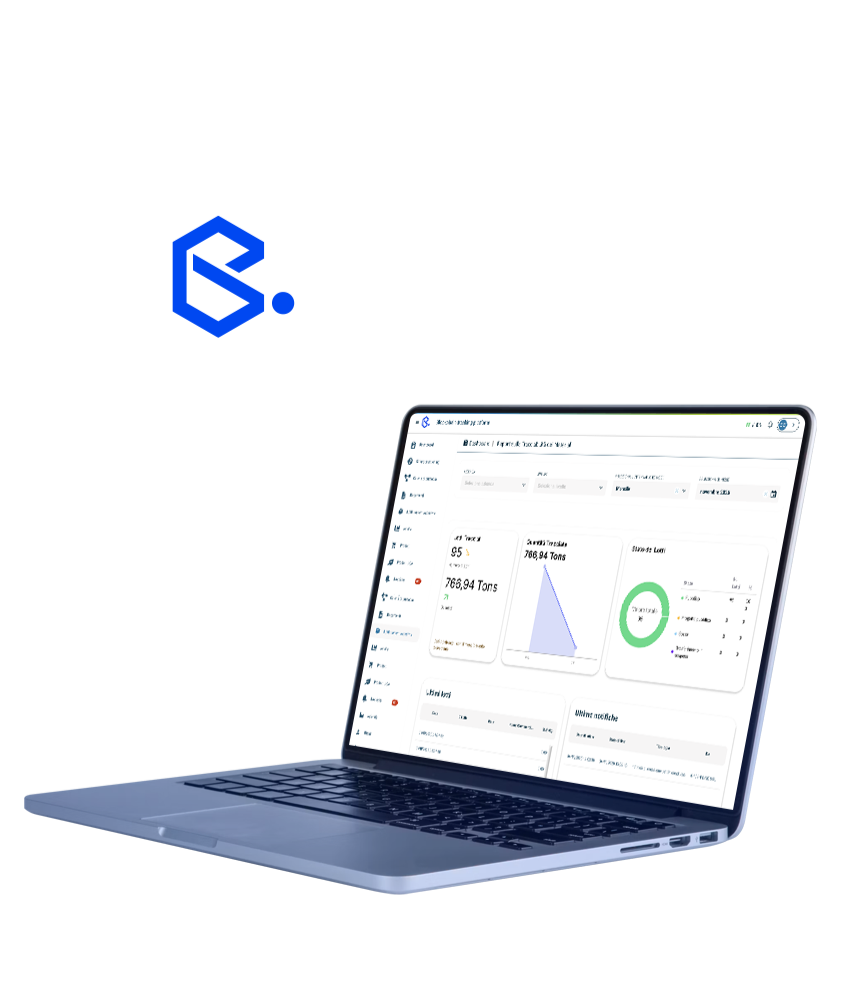
The proprietary platform that makes regulatory compliance simple, secure and scalable, guiding your company towards a sustainable transition.

Supply chain complexity
creates uncertainty

In modern supply chains information management becomes critical: the lack of shared standards and adequate tools makes it hard to ensure reliability, consistency and transparency.

  • Unverifiable data
  • Manual and fragmented processes
  • Compliance difficulties
  • Lack of transparency between actors

Nest Company’s answer

B.Tracking, a patented platform

Designed with a no-code architecture and based on blockchain and chain of custody, B.Tracking lets you track, certify and share data along the entire supply chain, generating digital documents with legal value.

No-code approach

B.Tracking lets you quickly configure the operational functions needed for any specific application, removing the need for dedicated software development.
This ensures adaptability to any industrial and regulatory change, greater control for the customer and significant cost savings.

Custom modules

The platform uses customisable modules to automatically generate digital product passports (DPP), digital chains of custody (DCoC), audit-ready reports and much more.

Multiple interface

The platform integrates two different interfaces, which interact with the user and with the blockchain ledger respectively.

Operational scalability

B.Tracking is already operational in several industrial sectors, from recycled plastic to textiles, from marine waste collection to industrial waste management.

The patent

An invention to store and authenticate information

The invention concerns the field of information technology for storing and authenticating information and relates to an IT platform that lets users interact with a data archive able to store information in an immutable and verifiable way.
(Italian patent granted No. 102022000001244)

How it works

The first system combining certified traceability, regulatory compliance and environmental governance in a single platform

B.Tracking diagram: data collection along the supply chain (Smart Questioning, Digital Authenticated Declaration), recording on the Nest Chain blockchain, sharing with stakeholders (ESPR-compliant Digital Product Passport, ISO 22095 Digital Chain of Custody, Smart Due Diligence, Audit-Ready Report)

Verifiable certified data

Digital Authenticated Declaration

The Digital Authenticated Declaration is a key element of modern digital ecosystems and advanced supply chains: it allows moving from a model based on declared trust to one based on verifiable trust.

It is the digital equivalent of a signed official declaration, but with advanced features:

  • It is generated and managed in native digital format
  • It is authenticated using cryptographic technologies (e.g. digital signatures, blockchain)
  • It is immutable or traceable over time
  • It can be verified independently by third parties

It is used to certify and share critical information along the supply chain, for example to:

  • Ensure full traceability along the supply chain
  • Prove the origin of materials and components
  • Ensure regulatory compliance and certifications
  • Prevent fraud and counterfeiting
  • Support sustainability claims (e.g. responsible sourcing)

  • Data reliability: information is not only declared but also authenticable
  • Transparency: all actors can access verifiable data
  • Fraud reduction: lower risk of false or unprovable claims
  • Operational efficiency: no more paper documentation and manual checks
  • Regulatory compliance: concrete support for increasingly strict regulatory requirements
1. The supplier sends material and its technical data to a company. 2. The company uploads the information to the B.Tracking platform and generates a digital declaration. 3. The declaration is sent to the supplier for signature and verification. 4. The supplier signs it digitally to make it official and verifiable. 5. The authenticated declaration is stored on B.Tracking and linked to the material via QR code, accessible for audits, quality checks and ESG traceability.

Guided, dynamic data collection

Smart Questioning

Smart Questioning is a key element in turning data management into an intelligent, adaptive and quality-oriented process.

It simplifies regulatory and operational complexity while ensuring precision, efficiency and scalability in collecting information.

An advanced questioning system that turns data collection from a static, repetitive activity into a guided, efficient and intelligent process, in which questions:

  • Adapt based on previous answers
  • Are contextual to the role, process or product
  • Evolve according to rules, data models and regulatory requirements

In the context of the Digital Product Passport, Smart Questioning is essential to:

  • Guide suppliers and operators in filling in data correctly
  • Reduce the complexity of regulatory requirements
  • Ensure the completeness and quality of the information collected
  • Adapt automatically to different product categories, markets and regulations, and supply chain tiers

  • Operational efficiency: less time needed to enter data
  • Fewer errors: no unnecessary or ambiguous requests
  • Improved user experience: simple, guided and intuitive interaction
  • Regulatory alignment: questions automatically reflect updated requirements
  • Data quality: more complete, consistent and reliable information
Smart Questioning flow: 1 suppliers, 2 incoming material, 3 qualification and document request, 4 data entry, 5 production and certified data.

Certified traceability

Chain of Custody

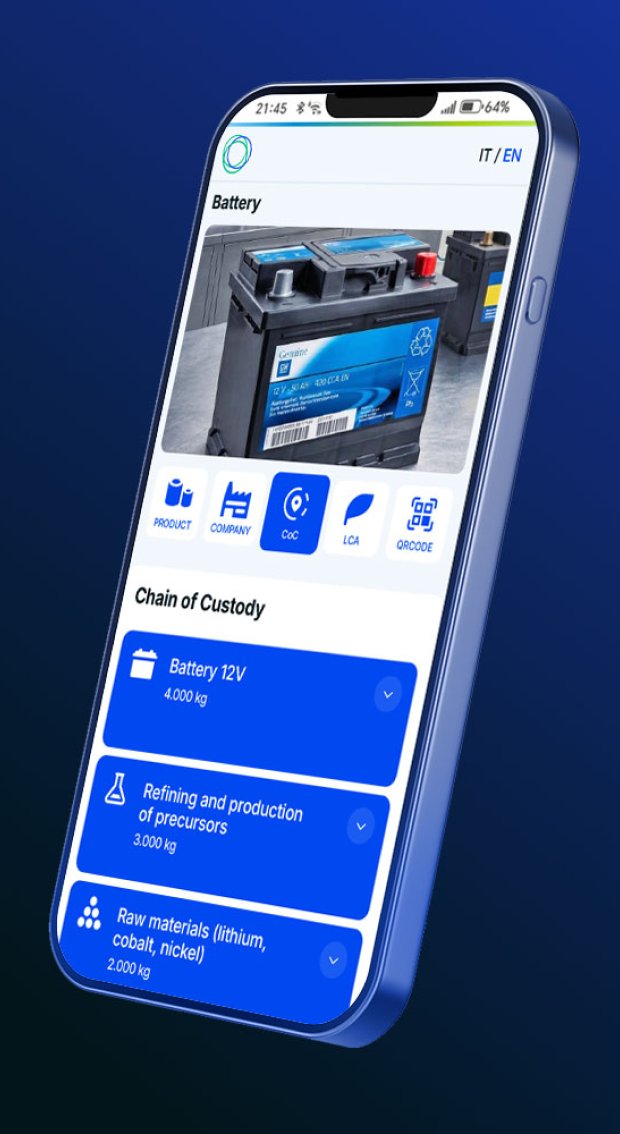
The Chain of Custody (CoC) lets you track and document the path of a product, material or piece of information along the entire supply chain, from its origin to the end consumer, ensuring data integrity and verifiability.
The main goal is to ensure that every step is transparent, verifiable and compliant, preserving the integrity of the information associated with the product.

The CoC continuously records and links:

  • Who handled the product (supplier, manufacturer, distributor)
  • What was transferred or transformed
  • Where each stage of the supply chain took place
  • How the product was processed or modified

The CoC becomes essential to:

  • Ensure full traceability along the supply chain
  • Prove the origin of materials and components
  • Ensure regulatory compliance and certifications
  • Support sustainability claims (e.g. responsible sourcing)

  • End-to-end transparency
  • Greater trust between stakeholders
  • Reduced risk of errors and fraud
  • Easier audits and certifications
  • Concrete support for sustainability and the circular economy

Unified ecosystem

ERP integration

The B.Tracking platform can be connected to other business applications (for example CRM or e-commerce) to create a single infrastructure working in synergy.
Benefits

  • Synchronises data in real time across different systems
  • Automates workflows
  • Integration via API
  • Better decisions as a result, made on complete data

Sankey diagrams

Reports and Documentation

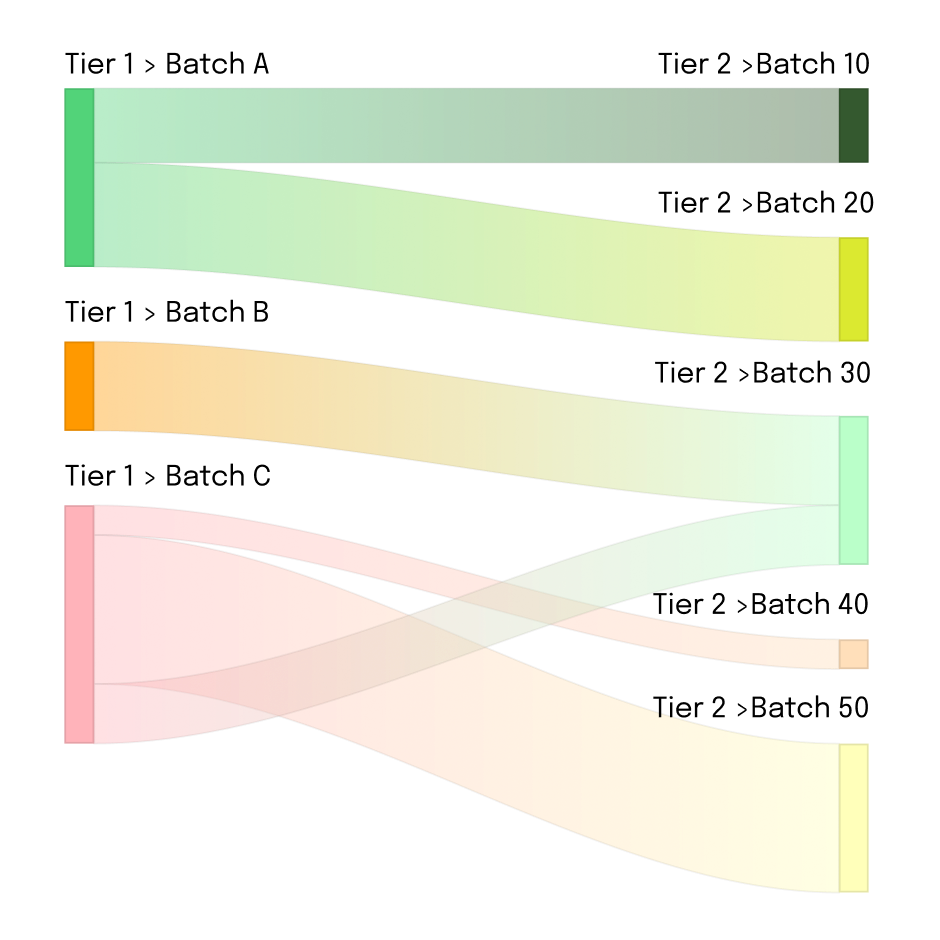
Thanks to the ability to track and record every single step of the chain of custody immutably, detailed reports and balance documents can be generated efficiently in the form of Sankey diagrams.

Material flows between the different tiers of the supply chain show how production batches are transformed and converge along the process. This visualisation not only makes it easier to monitor production flows, but also makes it easy to generate balances reflecting resource consumption, material origin and operational efficiency.
Benefits

  • Better monitoring of production flows
  • Automatic generation of balances
  • Reduces human error and increases operational efficiency
Sankey diagram: Tier 1 batches (Batch A, B, C) flow into Tier 2 batches (Batch 10-50)

Digital product identity

Digital Product Passport

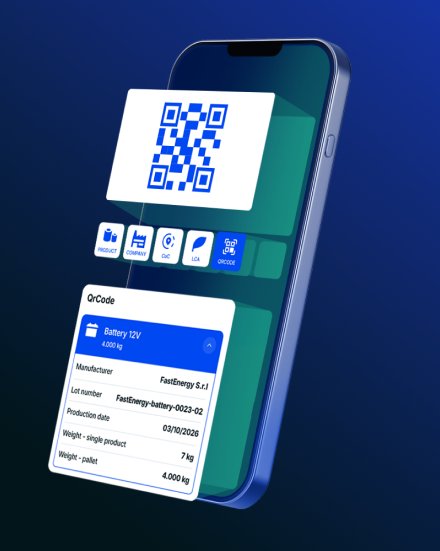
The DPP is the product’s digital identity, one of the possible outputs of our trust, compliance and data governance infrastructure.

Ensures data transparency and traceability

Shares information uniquely via QR code
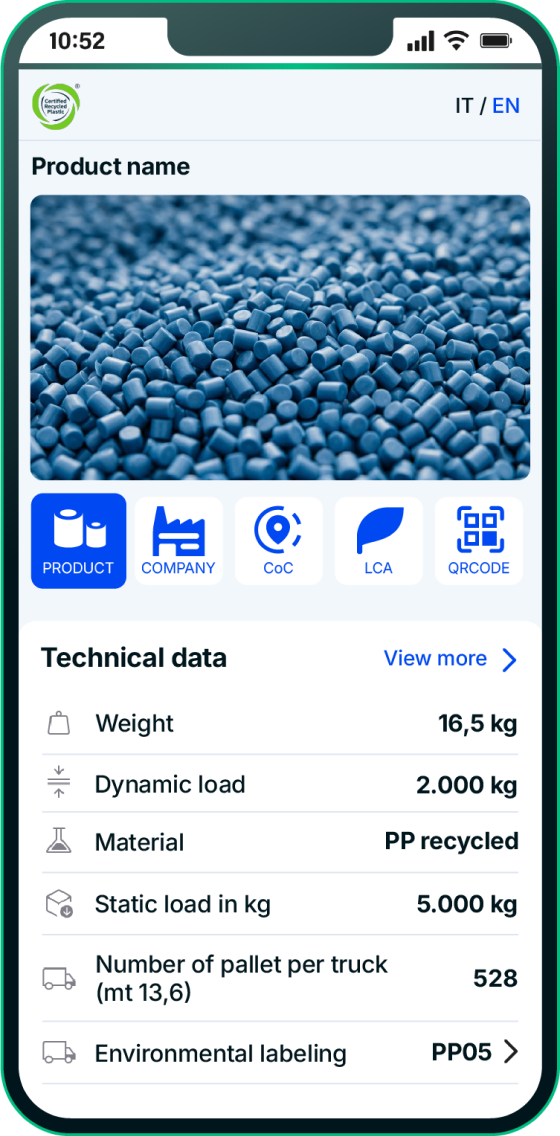
Example of a Digital Product Passport on a smartphone

Provides material data, making product repair and recycling easier

Aligns with the European ESPR regulations

The advantages of B.Tracking

Be Innovative. Be Smart. B.tracking

Regulatory compliance

B.Tracking is the integrated digital solution designed to guide your company towards a sustainable transition.

Improve your company’s efficiency

B.Tracking is the integrated digital solution designed to guide your company towards a sustainable transition.

Enhance the value of your company

B.Tracking is the integrated digital solution designed to guide your company towards a sustainable transition.

Authentic sustainability

B.Tracking is the integrated digital solution designed to guide your company towards a sustainable transition.

Building value together

Bring your company into the world of certified data

Enable reliable processes, reduce operational risk and guarantee the quality of information along the entire value chain. Choose Nest Company’s technology.

Contact us

1. POLICY AND MANAGEMENT COMMITMENT

1.1 Policy Statement

The Management of The Nest Company Srl (TNC), aware of the strategic importance of quality and information security in the context of SMEs working with significantly larger enterprise clients, has implemented an appropriate Integrated Management System (IMS) aligned with the principles of ISO 9001:2015 and ISO/IEC 27001:2022 standards, extended to ISO/IEC 27017.

The management of chain of custody, authenticated digital declarations, and the digital product passport involves handling sensitive and critical data for our clients. TNC recognizes that client trust is based on the continuous demonstration of technical competence, regulatory compliance, and management maturity comparable to the highest industry standards.

1.2 Strategic Objectives

Quality Objectives

  • Deliver software and services that meet the specifications and contractual commitments agreed with clients.
  • Ensure that development projects meet traceability, authenticity, and data integrity requirements.
  • Enhance the professional skills of employees and collaborators.
  • Develop innovation initiatives while respecting security and compliance constraints.
  • Maintain a performance-based results evaluation system.

Information Security Objectives

  • Ensure confidentiality, integrity, availability, and resilience of information.
  • Ensure full awareness of managed information and evaluation of its criticality.
  • Guarantee secure access by preventing unauthorized processing.
  • Ensure secure collaboration with third parties.
  • Promote awareness of security-related issues.
  • Promptly detect anomalies and incidents.
  • Ensure authorized access to operational facilities.
  • Ensure compliance with legal and contractual requirements.
  • Detect abnormal events and vulnerabilities.
  • Ensure Business Continuity and Disaster Recovery.

1.3 Commitment of Top Management

  1. Provide adequate resources: Allocate human, technical, and financial resources for the IMS.
  2. Establish clear governance: Define roles, responsibilities, and reporting structures.
  3. Ensure competence: Guarantee continuous staff training.
  4. Promote a security culture: Integrate security into the company culture.
  5. Manage the supply chain: Ensure security standards are applied to suppliers as well.
  6. Monitor and review: Conduct annual reviews of performance and processes.
  7. Communicate the policy: Publish it on the website and communicate it internally.